
CAN Bus Decoder: Decode CAN Frames with Your DBC
A raw CAN frame is an identifier and up to eight bytes of data. Decoding turns those bytes into named values with units, such as a temperature in °C or a speed in rpm. This page explains how that works for 11-bit and 29-bit identifiers, how a DBC file describes each signal, and how byte order, scaling and offset turn raw bits into engineering values.
What Is in a CAN Frame
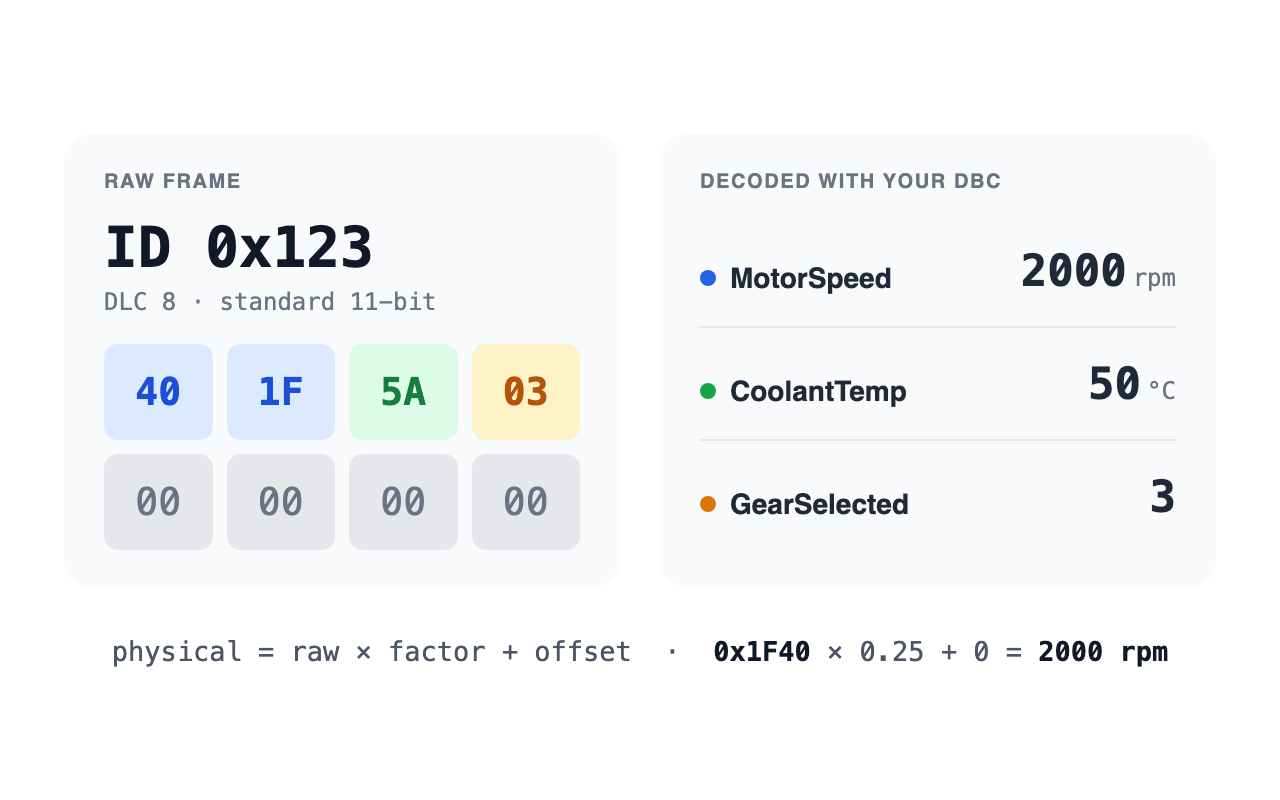
Every classic CAN data frame carries the same few fields. A decoder reads the identifier to work out which message it is, then reads the data bytes as that message’s definition describes.
| Field | Size | What it tells you |
|---|---|---|
| Identifier | 11 bits (standard) or 29 bits (extended) | Which message this is. A lower value wins arbitration, so it also sets the priority. |
| IDE bit | 1 bit | Whether the identifier is standard (11-bit) or extended (29-bit). |
| DLC | 4 bits | How many data bytes follow (0–8 for classic CAN). |
| Data | 0–8 bytes | The payload. On its own it is just numbers; the message definition gives it meaning. |
11-bit and 29-bit identifiers
Standard identifiers run from 0x000 to 0x7FF (2,048 values). Extended identifiers run up to 0x1FFFFFFF. Both can share one bus. The identifier alone does not say what the data means: the same ID can carry different content on two different machines, so you always decode against the definitions for the network in front of you.
How a DBC File Describes Signals
A DBC file is a text database that lists each message (by identifier and length) and the signals packed inside it. For every signal it records:
- Start bit and length: where the signal sits in the payload and how many bits it uses.
- Byte order: little-endian (“Intel”) or big-endian (“Motorola”).
- Signed or unsigned: how to read the raw bits as an integer.
- Factor and offset: the linear scaling,
value = raw × factor + offset. - Unit, minimum and maximum: what the value means and its valid range.
Without the DBC (or an equivalent definition from the device maker), a decoder can show you identifiers, timing and raw bytes, but not names or units.
Worked example
Suppose your DBC defines message 0x123 with a 16-bit unsigned signal MotorSpeed at start bit 0, little-endian, factor 0.25, offset 0, unit rpm. A frame arrives:
ID 0x123 DLC 8 40 1F 00 00 00 00 00 00
- Take bits 0–15. Little-endian puts the low byte first, so the raw value is
0x1F40= 8000. - Scale it: 8000 × 0.25 + 0 = 2000 rpm.
Had the same signal been defined big-endian, the bytes would be read in the opposite order and give a different number. That is why byte order is the most common source of decoding mistakes.
Intel vs Motorola byte order
In little-endian (Intel) signals, the least significant byte comes first and the signal grows toward higher bytes. In big-endian (Motorola) signals, the most significant byte comes first. DBC files also number Motorola start bits differently, so a tool must follow the file’s convention exactly. If decoded values look wildly wrong but change smoothly, check the byte order first.
Multiplexed signals
Some messages reuse the same bytes for different content. A multiplexer signal (often the first byte) says which set of signals the rest of the payload holds in this frame. The DBC marks the multiplexer and which signals belong to each of its values.
When You Don’t Have a DBC
Many messages, especially manufacturer-specific ones, come with no public definition. You can still learn a lot from raw traffic: which identifiers are present, how often each one repeats, and which bytes change when you operate the machine. Turning that into a reliable definition is careful work.
Once you know each message’s size and rate, the bus load guide shows how much of the bus they use.
Frequently Asked Questions
What is a CAN bus decoder?
A CAN decoder reads raw CAN frames (an identifier plus data bytes) and converts them into named signals with units, using a message definition such as a DBC file.
What is a DBC file?
A DBC file is a text database that defines the messages on a CAN network and the signals inside each one: start bit, length, byte order, sign, factor, offset, unit and range.
What is the difference between 11-bit and 29-bit CAN IDs?
Standard frames use an 11-bit identifier (0x000–0x7FF); extended frames use a 29-bit identifier (up to 0x1FFFFFFF). Both can share a bus, and the IDE bit in each frame says which kind it is.
What is the difference between Intel and Motorola byte order?
Intel (little-endian) signals store the least significant byte first; Motorola (big-endian) signals store the most significant byte first. Reading a signal with the wrong byte order gives incorrect values.
How is a raw CAN value converted to a physical value?
Extract the signal’s bits, read them as a signed or unsigned integer, then apply the linear scaling: physical value = raw × factor + offset.
Can I decode CAN data without a DBC file?
You can see identifiers, timing and raw bytes, but not signal names or units. Those need a definition from the DBC, the device maker, or careful reverse engineering of the traffic.
Learn to Read Any CAN Network
CAN Principles and Practice, our complete CAN bus course, covers frames, identifiers, signals and hands-on decoding.
Questions about decoding your network? Contact us.